

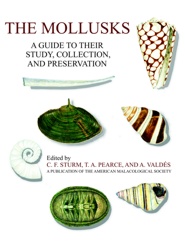
The Mollusks
A Guide to Their Study, Collection, and Preservation
by C. F. Sturm, T. A. Pearce, and A. Valdes (eds.)

Author website: http://www.malacological.org/
- Number of Pages: 457
- ISBN-10: 1581129300
- ISBN-13: 9781581129304
- Publisher: Universal-Publishers
- Year: 2006
- Category: Textbooks & Study Guides, Biology & Natural Sciences
Synopsis
Mollusks have been important to humans since our earliest days. Initially, when humans were primarily interested in what they could eat or use, mollusks were important as food, ornaments, and materials for tools. Over the centuries, as human knowledge branched out and individuals started to study the world around them, mollusks were important subjects for learning how things worked. In this volume, the editors and contributors have brought together a broad range of topics within the field of malacology. It is our expectation that these topics will be of interest and use to amateur and professional malacologists.About the Author
C. F. Sturm, Research Associate, Carnegie Museum of Natural History, Pittsburgh, PAT. A. Pearce, Curator Carnegie Museum of Natural History, Pittsburgh, PA
A. Valdés, Curator Los Angeles County Museum of Natural History, Los Angeles, CA
Paperback
$35.95
Order from Universal-Publishers
457 Pages (sold non-returnable)
Order from 

Order from 
PDF Sample
First 25 Pages: Free
 Download first 25 pages
 Size: PDF 1083k



 View or Post a Review at Amazon.com
